

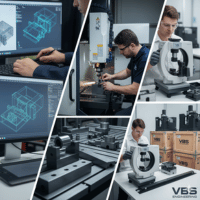
In the fast-paced packaging world, manufacturers demand equipment they can trust, and nowhere is trust more critical than in the precision operation of a pneumatic punch. A perfect hole isn't just luck; it's the result of meticulous planning, skilled craftsmanship, and an unwavering commitment to quality assurance.
At VBS Engineering, we believe the quality of the final product is directly tied to the rigor of its creation. This article takes you behind the scenes, revealing the end-to-end manufacturing process that transforms raw materials and advanced technology into the durable, accurate, and high-performance punches that drive modern packaging lines.
Phase 1: Meticulous Planning and Digital Precision
Every VBS Engineering punch begins its life not on the shop floor, but in the digital realm. This crucial initial phase ensures that the final physical product meets the tightest specifications and performs flawlessly when integrated into your existing machinery.
1. Advanced 3D Design Modeling (CAD)
Our engineering team utilizes cutting-edge Computer-Aided Design (CAD) software to create a comprehensive 3D model of the punch. This isn't just a basic sketch; it's a digital prototype where every component—from the piston to the cutting die—is modeled with micro-tolerance accuracy.
- Virtual Prototyping: We simulate material stress, airflow dynamics, and cutting action within the model. This allows us to identify and resolve potential tolerance issues or design flaws before any metal is cut, drastically reducing development time and material waste.
- Seamless Integration: The 3D model allows us to precisely visualize how the punch will interact with your specific machine frame and material web, ensuring seamless integration and minimizing on-site adjustments.
2. Material Selection and Tooling Strategy
Precision punching requires materials that can withstand incredible repetitive stress. We select only the highest-grade tool steels and specialized alloys, chosen specifically for their hardness, wear resistance, and long-term durability. The material choice is meticulously matched to the customer's application (e.g., film, laminate, foil) to guarantee peak performance and longevity.
Phase 2: Skilled Craftsmanship and Precision Machining
Once the design is finalized and materials are sourced, the process moves to our advanced manufacturing facility, where technology meets the dedication of our skilled artisans.
1. CNC Precision Machining
The core components of our punches are created using state-of-the-art Computer Numerical Control (CNC) machinery. These machines execute the complex geometries developed in the 3D models with unmatched precision:
- Micro-Accuracy: Our CNC centers hold tolerances often measured in a few micrometers, essential for the flawless alignment between the cutting die and the punch blade. This level of accuracy is what ensures the clean, accurate, and burr-free holes our customers rely on.
- Surface Finish: Crucial operational surfaces are machined to a highly polished finish to reduce friction, minimize heat generation, and extend the lifespan of the seals and moving parts.
2. Specialized Heat Treating and Hardening
The most critical step for durability is the heat treating process. The specialized tool steels used for the cutting components are subjected to controlled heating and cooling cycles. This process fundamentally alters the molecular structure of the metal, maximizing its hardness and resistance to wear. A properly heat-treated die is what allows our punches to maintain their sharp edge and accuracy through millions of cycles.
3. Expert Assembly and Calibration
The individual, precision-machined components are brought together by our experienced technicians. Assembly is not simply 'putting parts together'; it's a process of meticulous alignment and calibration.
- Hand-Tuned Alignment: The core cutting components—the punch and the die—are hand-fitted and aligned under magnification to ensure perfect concentricity and clearance. This final, manual step is where skilled craftsmanship guarantees the exceptional performance of the machine.
Phase 3: Rigorous Inspection and Quality Assurance (QA)
The manufacturing process concludes with a non-negotiable step: rigorous quality assurance and testing. No punch leaves VBS Engineering without proving its durability and accuracy.
1. Multi-Point Component Inspection
Before assembly, every component is measured against its digital blueprint using advanced metrology equipment, including Coordinate Measuring Machines (CMMs) and optical comparators. This check verifies that every dimension, angle, and surface finish meets our exacting standards.
2. Functional Performance Testing
The completed punch unit undergoes a comprehensive battery of tests simulating real-world packaging line conditions:
- Cycle Testing: The punch is run through hundreds of thousands of rapid cycles to test the durability of the seals, the performance of the pneumatic actuator, and the integrity of the mechanical structure.
- Material Testing: The punch is used to cut the exact material specified by the customer. The resulting holes are visually inspected and measured to verify cutting accuracy, cleanliness, and consistency at maximum operating speed.
3. Documentation and Certification
Upon passing all tests, the punch is fully documented, including a performance report and a quality certification. This complete traceability ensures that every VBS Engineering punch delivers on its promise of superior durability, accuracy, and long-term performance.
Technology Meets Dedication
At VBS Engineering, we don’t just manufacture pneumatic punches; we engineer a critical performance component for your production line. By uniting cutting-edge 3D design and CNC technology with meticulous craftsmanship and a relentless focus on quality assurance, we ensure that every punch we deliver is a testament to reliability and precision. This end-to-end process is our commitment to helping your industry stay ahead of the curve.