
Top 5 Factors to Consider When Choosing a Pneumatic Punch for Your Packaging Line

Top 5 Factors to Consider When Choosing a Pneumatic Punch for Your Packaging Line

In the high-stakes world of flexible packaging, the smallest component can have the biggest impact. The wrong pneumatic punch can lead to material tearing, inconsistent cuts, frequent downtime, and a cascade of lost productivity. The simple truth is: Not all punches are created equal.

For business owners, packaging engineers, and production managers, selecting the right punching unit is a critical decision that affects performance, speed, and ultimately, product quality. This comprehensive guide, leveraging expert insights from VBS Engineering, breaks down the key factors you must consider to match the ideal pneumatic punch to your specific packaging application, ensuring long-term reliability and a sustained boost in production output.


1. Understanding Your Material: Strength and Composition

The first, and most crucial, consideration is the material you are punching. The physical properties of the film or laminate dictate the necessary punch design and power.

Material Type Key Challenges Punch Requirement
Thin Films (e.g., Polyethylene) Prone to stretching and tearing; requires ultra-sharp tools and minimal force dwell time. Precision-ground, minimal clearance dies to ensure a clean cut without pulling the material.
Thick Laminates (Multi-layer) High density and cumulative thickness require greater force to cut cleanly. Robust actuator with high thrust capacity; specialized tool steel for maximum wear resistance.
Foil/Aluminum-Based Prone to burrs and deformation. Highly accurate clearance between the punch and die to minimize deformation and create a clean edge.

Export to Sheets

VBS Engineering Insight: We analyze the material's composition, thickness, and web speed to recommend the optimal tool steel and punch-to-die clearance. A clearance that is too small can dull the die quickly, while one that is too large will produce a poor-quality cut.


2. Air Pressure Compatibility and Power Requirements

A pneumatic punch’s performance is directly tied to its air pressure source. Understanding your plant’s capabilities and the punch’s required operating pressure is essential.

  • Operating Pressure: Different punches require different minimum operating pressures to deliver the necessary cutting force (thrust). A common mistake is underestimating this requirement, which leads to weak, incomplete cuts.
  • Air Consumption: For high-volume lines, the speed and efficiency of the punch must be balanced against its air consumption. Modern VBS Engineering designs focus on optimized airflow circuits to deliver maximum thrust with minimal air usage, leading to energy savings.
  • Consistency: Pressure fluctuations can cause inconsistent hole quality. We help ensure your system includes appropriate air preparation units (filters, regulators, lubricators) to maintain a stable, clean air supply to the punch.

3. The Geometry of Function: Hole Shape and Complexity

The required hole shape—whether a simple round hole, a Euro-slot, a complex handle, or a tear notch—significantly impacts the punch’s design, cost, and maintenance needs.

  • Standard Shapes (Round, Slot): These allow for modular, easily replaceable components and generally have lower maintenance requirements.
  • Custom Shapes (Handles, Unique Vents): These require more complex tooling, custom-machined dies, and more intricate punch-to-die alignment. While they offer branding opportunities, they also demand a more rigorous quality assurance and maintenance schedule.
  • Cleanliness and Ejection: Complex shapes must be designed with efficient slug ejection mechanisms to prevent material buildup, which is a leading cause of miscuts and unplanned stops.

4. Maintenance Needs and Downtime Mitigation

Production lines live and die by uptime. The best punch is one that is reliable and easy to maintain.

  • Modular Design: Look for punches with modular components (e.g., quick-change die cassettes). This allows operators to replace worn-out cutting components quickly without removing the entire punch body from the machine, dramatically reducing changeover and maintenance time.
  • Longevity of Components: Higher quality, specialized tool steels (like those used by VBS Engineering) require a higher initial investment but offer significantly extended lifespan, pushing the maintenance cycle further apart and saving money in the long run.
  • Accessibility: Ensure the punch is designed for easy access to wear parts, simplifying routine inspection and lubrication.


5. Customization Options: Future-Proofing Your Investment

In a dynamic packaging industry, your punch must be able to adapt. The ideal supplier offers robust customization options.

  • Integration Compatibility: Can the punch be easily integrated into different types of converting or packaging machines (form-fill-seal, bag makers, rewinders)? VBS Engineering designs universal mounting patterns and flexible controls to ensure seamless integration into new or legacy equipment.
  • Retrofit Capabilities: As your product line evolves, you may need to add sensors or cooling features. Choosing a customizable punch body allows for future retrofitting without replacing the entire unit.

Partnering for Precision and Performance

Selecting a pneumatic punch is a long-term investment in your production quality. By meticulously evaluating the five key factors—material strength, air pressure, hole shape, maintenance needs, and customization options—you move from simply buying equipment to strategically investing in high-performance tooling.

Don’t leave this critical choice to chance. VBS Engineering offers the expert insight to analyze your specific packaging application and deliver a pneumatic punching solution engineered for long-term reliability, minimal waste, and maximum production output. Contact our team today to ensure your next punch is the perfect punch.
From Design to Delivery: The Art of Building Reliable Pneumatic Punches

From Design to Delivery: The Art of Building Reliable Pneumatic Punches

In the fast-paced packaging world, manufacturers demand equipment they can trust, and nowhere is trust more critical than in the precision operation of a pneumatic punch. A perfect hole isn't just luck; it's the result of meticulous planning, skilled craftsmanship, and an unwavering commitment to quality assurance.

At VBS Engineering, we believe the quality of the final product is directly tied to the rigor of its creation. This article takes you behind the scenes, revealing the end-to-end manufacturing process that transforms raw materials and advanced technology into the durable, accurate, and high-performance punches that drive modern packaging lines.


Phase 1: Meticulous Planning and Digital Precision

Every VBS Engineering punch begins its life not on the shop floor, but in the digital realm. This crucial initial phase ensures that the final physical product meets the tightest specifications and performs flawlessly when integrated into your existing machinery.

1. Advanced 3D Design Modeling (CAD)

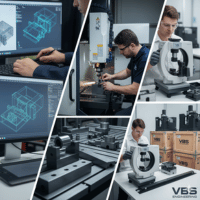
Our engineering team utilizes cutting-edge Computer-Aided Design (CAD) software to create a comprehensive 3D model of the punch. This isn't just a basic sketch; it's a digital prototype where every component—from the piston to the cutting die—is modeled with micro-tolerance accuracy.

  • Virtual Prototyping: We simulate material stress, airflow dynamics, and cutting action within the model. This allows us to identify and resolve potential tolerance issues or design flaws before any metal is cut, drastically reducing development time and material waste.
  • Seamless Integration: The 3D model allows us to precisely visualize how the punch will interact with your specific machine frame and material web, ensuring seamless integration and minimizing on-site adjustments.

2. Material Selection and Tooling Strategy

Precision punching requires materials that can withstand incredible repetitive stress. We select only the highest-grade tool steels and specialized alloys, chosen specifically for their hardness, wear resistance, and long-term durability. The material choice is meticulously matched to the customer's application (e.g., film, laminate, foil) to guarantee peak performance and longevity.


Phase 2: Skilled Craftsmanship and Precision Machining

Once the design is finalized and materials are sourced, the process moves to our advanced manufacturing facility, where technology meets the dedication of our skilled artisans.

1. CNC Precision Machining

The core components of our punches are created using state-of-the-art Computer Numerical Control (CNC) machinery. These machines execute the complex geometries developed in the 3D models with unmatched precision:

  • Micro-Accuracy: Our CNC centers hold tolerances often measured in a few micrometers, essential for the flawless alignment between the cutting die and the punch blade. This level of accuracy is what ensures the clean, accurate, and burr-free holes our customers rely on.
  • Surface Finish: Crucial operational surfaces are machined to a highly polished finish to reduce friction, minimize heat generation, and extend the lifespan of the seals and moving parts.

2. Specialized Heat Treating and Hardening

The most critical step for durability is the heat treating process. The specialized tool steels used for the cutting components are subjected to controlled heating and cooling cycles. This process fundamentally alters the molecular structure of the metal, maximizing its hardness and resistance to wear. A properly heat-treated die is what allows our punches to maintain their sharp edge and accuracy through millions of cycles.

3. Expert Assembly and Calibration

The individual, precision-machined components are brought together by our experienced technicians. Assembly is not simply 'putting parts together'; it's a process of meticulous alignment and calibration.

  • Hand-Tuned Alignment: The core cutting components—the punch and the die—are hand-fitted and aligned under magnification to ensure perfect concentricity and clearance. This final, manual step is where skilled craftsmanship guarantees the exceptional performance of the machine.


Phase 3: Rigorous Inspection and Quality Assurance (QA)

The manufacturing process concludes with a non-negotiable step: rigorous quality assurance and testing. No punch leaves VBS Engineering without proving its durability and accuracy.

1. Multi-Point Component Inspection

Before assembly, every component is measured against its digital blueprint using advanced metrology equipment, including Coordinate Measuring Machines (CMMs) and optical comparators. This check verifies that every dimension, angle, and surface finish meets our exacting standards.

2. Functional Performance Testing

The completed punch unit undergoes a comprehensive battery of tests simulating real-world packaging line conditions:

  • Cycle Testing: The punch is run through hundreds of thousands of rapid cycles to test the durability of the seals, the performance of the pneumatic actuator, and the integrity of the mechanical structure.
  • Material Testing: The punch is used to cut the exact material specified by the customer. The resulting holes are visually inspected and measured to verify cutting accuracy, cleanliness, and consistency at maximum operating speed.

3. Documentation and Certification

Upon passing all tests, the punch is fully documented, including a performance report and a quality certification. This complete traceability ensures that every VBS Engineering punch delivers on its promise of superior durability, accuracy, and long-term performance.


Technology Meets Dedication

At VBS Engineering, we don’t just manufacture pneumatic punches; we engineer a critical performance component for your production line. By uniting cutting-edge 3D design and CNC technology with meticulous craftsmanship and a relentless focus on quality assurance, we ensure that every punch we deliver is a testament to reliability and precision. This end-to-end process is our commitment to helping your industry stay ahead of the curve.

Redefining Precision: How Pneumatic Punch Technology Transforms Packaging

Redefining Precision: How Pneumatic Punch Technology Transforms Packaging

Precision Power: Revolutionizing Packaging with Advanced Pneumatic Punching Machines

In the hyper-competitive world of modern packaging, the demands for speed, precision, and efficiency have never been higher. Manufacturers working with flexible materials—from pouches and bags to films and laminates—know that even a millisecond of delay or a millimeter of error can impact the bottom line. The solution? Advanced pneumatic punching machines. These aren't the basic punches of yesterday; they are sophisticated systems leveraging automation and precision engineering to deliver clean, accurate holes, setting a new standard for quality and throughput.

This is a deep dive into how modern pneumatic technology, like that pioneered by VBS Engineering, is transforming the flexible packaging sector, boosting production consistency, minimizing waste, and guaranteeing superior product quality.


The Pneumatic Advantage: Why Air Power Wins

Pneumatic systems—those powered by compressed air—offer several inherent advantages that make them ideal for the demanding requirements of the packaging industry:

  • Speed and Responsiveness: Compressed air provides an almost instantaneous power source, enabling extremely fast cycle times. This rapid response is crucial for high-speed production lines where thousands of cuts per minute are common.
  • Clean and Low-Maintenance: Unlike hydraulic or mechanical systems that often require complex lubrication, pneumatic components are inherently cleaner. They present a lower risk of material contamination and require minimal maintenance, translating directly into less downtime.
  • Simple and Durable Design: Pneumatic components are robust and simple in design, allowing them to withstand the rigorous, repetitive demands of continuous production environments.


Beyond Basic Punching: The Role of Advanced Engineering

The real revolution comes from integrating advanced engineering and automation with the core pneumatic technology. This synergy creates punching solutions that are far more accurate and reliable than previous generations.

1. Unmatched Precision and Accuracy

The goal of any punching operation is the perfect hole—cleanly cut, perfectly sized, and consistently placed. Modern pneumatic punching machines achieve this through:

  • Micro-Tolerance Manufacturing: The dies and blades are engineered to extremely tight tolerances. When coupled with the precise force and speed control of the pneumatic actuator, this ensures a clean cut every time, eliminating the frayed edges, material pulling, and "crows' feet" that can lead to product defects.
  • Sensor Integration: Advanced systems incorporate sensors and encoders to monitor the punching process in real-time. This feedback loop allows the machine to self-adjust to minor fluctuations in material speed or thickness, maintaining critical hole-placement accuracy.

2. Maximizing Efficiency and Minimizing Waste

Waste material is a direct hit to profitability. Manufacturers are constantly seeking ways to reduce scrap, and pneumatic punches are a key tool in this mission:

  • Controlled Force and Dwell Time: By allowing operators to precisely control the force applied and the "dwell time" (how long the punch is in contact with the material), the system ensures the material is cut, not crushed or damaged. This optimization drastically reduces the instance of material tearing or incomplete cuts.
  • Rapid Changeovers: Flexibility is vital. Modern units feature quick-change die systems that allow operators to swap out hole patterns or sizes in minutes, not hours. This reduction in setup time keeps the line running and increases overall equipment effectiveness (OEE).


The VBS Engineering Commitment: Innovation and Reliability

At VBS Engineering, we understand that a punching machine is more than just an assembly of components—it's a critical component of your entire production ecosystem. Our focus is on integrating innovation and proven reliability to solve the industry’s toughest challenges.

  • Automation Integration: Our pneumatic solutions are designed for seamless integration with high-speed automated packaging lines, ensuring the punch timing is perfectly synchronized with the material feed. This prevents production bottlenecks and ensures continuous flow.
  • Downtime Reduction: By utilizing high-quality, durable components and focusing on accessible, modular designs, VBS Engineering solutions are built for maximum uptime. When maintenance is required, the straightforward pneumatic architecture makes repairs faster and simpler.
  • Custom Solutions: We recognize that one size doesn't fit all. Whether you require standard handle punches, tear notches, or complex ventilation patterns, our engineering team collaborates with you to develop custom pneumatic solutions that meet the unique geometric and material specifications of your flexible packaging products.


Staying Ahead of the Curve

In today’s market, consumers judge product quality by its packaging. A clean, accurately placed hole for a hang-tab or a precise tear-notch directly contributes to the perception of a well-made product.

By adopting advanced pneumatic punching machines, manufacturers aren't just buying equipment; they are investing in an operational advantage: improved production consistency, significantly reduced downtime, and guaranteed higher product quality.

To stay ahead of the curve, it’s time to rethink the power of air. Partner with VBS Engineering to unlock the next level of precision and efficiency in your packaging operations.